|
Employer: |
CARLSBERG Bulgaria JSCo |
|
Site: |
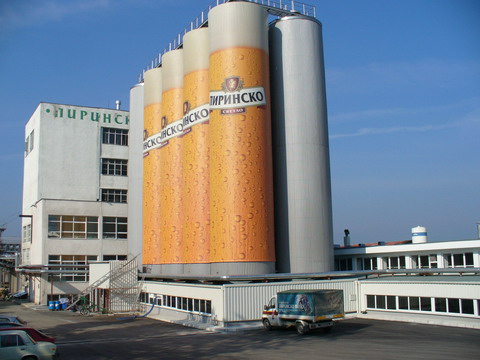
„Pirinsko Pivo”
brewеry |
|
Sub-site: |
Beer production |
|
Design: |
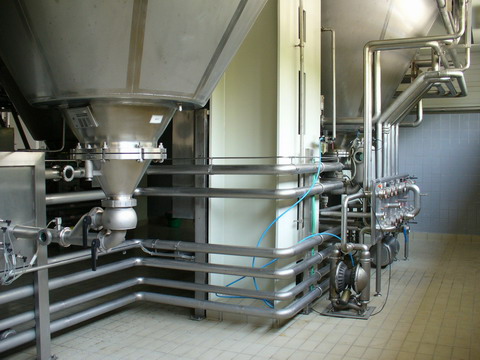
Control and monitoring system for: biotechnological process in 10 fermentation/ageing
tanks CCT, 4 yeast tanks, 6 conditioning tanks BBT; technological cleaning process (CIP) by 2 equipmentсs –
with 6 vessels and with 4 vessels |
|
Kinds of activities: |
Additional design implementation, commissioning
and staff training |
|
Performance: |
October 2005
– February 2006 |
|
Brief info about the project:
The project was implemented by
the specialists of START ENGINEERING JSCo – Branch Sofia.
The system comprises:
·
2 Operators
stations
COMPAQ – server-client interface communication.
The
server interacts with the PLC over SINEC H1
protocol.
·
The controller
(PLC) is
of
the
type
SIEMENS SIMATIC S5-115U, on the base of the CPU
945, a
communication module for SINEC H1 (industrial Ethernet) and
a communication module IM318 for the SINEC
L2 DP
communication
·
22 distributed
I/O
system
of
the
type
SIEMENS SIMATIC ET200 with communication modules integrated IM308
in
charge for the communication with the PLC over SINEC
L2 DP.
·
Field instrumentation
for
measuring
conductivity,
temperature,
flow
and
pressure;
level
switches
and
flow
switches
by
ENDRESS+HAUSER, about
160 proximity
switches
by
Schneider; about 250
pneumatic cut-off
valves
, 16 pneumatic
control valve by SAMSON, 10 variable frequency devices by DANFOSS
for el.motors speed control.
The
system
implements
the
execution
of
the
technological
procedures,
which
in
briefly
are:
From the
brew
installation
(“Brew
House”)
the
batch
of
worth
is
transferred
in
one
of
the
10 vessels
- ССТ (Cylinder Cone Tank), each
one of which with the storage capacity of 2500 hectoliters,
and
right after yeast is added from any of the three Yeast
tanks.
After
that
in
the
different
zones
of
the
ССТs
are
maintained
definite
temperatures
for
a
certain
amount
of
time
within
the bounds of two phases – fermentation
and aging.
The thus produced “live” beer is non-persistant,
and therefore the beer is put to a filtration and later on is
transferred to one of the 6 vessels of BBT
(Bright Beer Tank - 4 with the storage capacity of 840 hl
and 2 – with 1200
hl) for tranquillization and saturation with the default
amount of carbon dioxidе. Subsequently
maintaining
constant
pressure
the
beer
is
transferred
to
the
filling
plant
over
one
of
the
three
filling
lines:
RGB (intended
for glass bottles), PET (for polyethylene bottles)
and
KEG (for kegs).
Since there
are
biological
products,
which
take
huge
place
in
the
production,
essential
matter
for
the
genuine
quality
of
the
beer
is
the
cleaning
procedure
via
the
CIP
installation,
where
CIP
stands
for
Cleaning
In Place, and which consists of three subsequent phases:
1)
Preliminary rinse with water
2)
The thorough
cleaning
with
caustic
or
acid,
or
hot
water
(or
disinfectant)
3)
Post-held rinse with water.
There are two CIP
installations on site:
1)
Designed for cleaning all the vessels and pipes before filtration (ССТ,
Yeast
tanks)
2)
Designed for cleaning the whole equipment after filtration (BBT,
filling
lines)
The
first
one
comprises
6 vessels:
1)
for hot water,
2) for cold
water,
3) for hot
caustic,
4) for cold caustic,
5)
for acid and for 6) disinfectant.
Here
is
completely
available
and
admissible
the
simultaneous
operation
of,
for
example,
CCT
cold
cleaning
procedure and hot cleaning procedure on pipes,
for
saving time.
The
second
CIP
installation comprises
4 vessels:
1)
for acid, 2) for hot
caustic,
3) for cold caustic
or disinfectant and 4) for circulating water or hot water. Here
the
simultaneous
operation
(hot and cold cleaning) is not
possible.
The CIP
procedures
keep a strict close control on the temperature, concentration (by
conductivity) and time for transition of the chemical agents. Besides
they offer the technologists various recipes for performing different
cleanings, as well as allow them to change the very recipes.
The CIP
sequences
comprise
interlocks
for
failed
conditions,
and
in
addition
the
inform
the
operators
what
the
particular cause is
and
what
steps
should
take.
The above said for recipes,
interlocks, messages ... refers not only to CIP
programs, but also to the biotechnological
programs.
System
configuration
CCT
CCT cones